
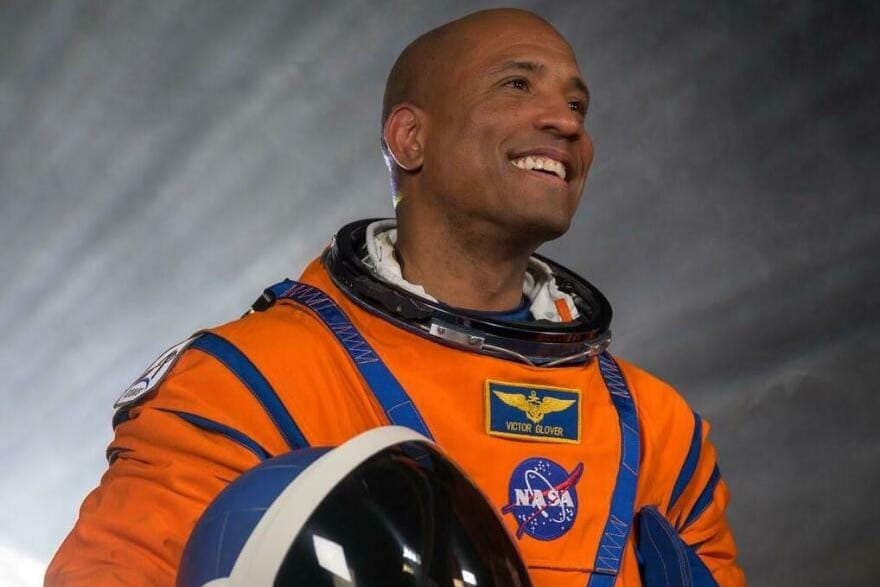
The last time humans went to the moon was in 1972, when Apollo 17 landed in the Moon’s Taurus-Littrow Valley. Since then, more than five decades have passed without another crewed lunar mission. And, in all that time, no Black astronaut has ever journeyed to the Moon. That is about to change.
More than 50 years later, history is set to be made with Artemis II, NASA’s upcoming crewed mission to deep space. During this mission, which will last approximately 10 days, Captain Victor Glover will become the first Black astronaut to travel to the Moon. Serving as the pilot for the mission, Glover will be joined by three other astronauts on this historic flight, which will take the crew around the Moon and back to Earth.
The significance of this moment is not lost on Glover. In an interview with ABC News, he reflected on the importance of representation and what it means for people to witness the first Black astronaut going to the Moon, in addition to the first woman. “I think people need to be able to see themselves in the things that they dream about and not just have to try to color it in their mind’s eye,” he said.
For Glover, what inspired him to want to be a pilot was a simple but profound moment in college. As a student, he saw one of his mentors, who was one of the few Black faculty members at his school, wearing his Navy uniform. That image opened a door of possibility that he never fully considered before. Just two years later, Glover joined the Navy, beginning a career that would take him on a journey from naval aviation to space exploration.

In 2013, the California native was selected as one of eight members of the 21st NASA astronaut class, and in 2018, he was assigned his first spaceflight mission. In 2021, he spent 168 days in space aboard the International Space Station, completing 4 spacewalks and several scientific, maintenance and outreach activities. In 2023, he received his assignment as Artemis II Pilot.
The mission builds on the success of Artemis I, in which an uncrewed test flight traveled around the Moon in 2022. This time, Artemis II will carry astronauts as it tests the rocket, life-support systems and crew controls. Although it is not designed to land on the Moon, it will conduct a lunar fly-by mission, allowing the crew to record observations and capture photographs that would advance lunar science and help prepare future missions to land astronauts on the Moon once again.